Friday, September 4, 2009

Goodfellows, Another Article, Chapter 3, New CG Project

Writing: Book One, Chapter 3, v.30.0
Watched: Monk, Season 7

This week marked my start as a post-graduate research fellow, and things seem to be much as I anticipated. One exception is my on-campus work space, which is lighter on the space (read: virtually nonexistent) that I was led to believe. Not really a problem, as it gives me a rather compelling argument to work from home more often than not, which really is more conducive to editing anyway. So in the end, the others at the office get dedicated work spaces, I--the homebody--get to stay home, and my supervisors still get the finished product they're after. In a way, it's not so different an arrangement from freelance editing, except that I have a dedicated client base built-in.

*

Crazy as it may sound, with Article Two only recently added to the publication queue, I'm entertaining notions of synthesizing the content from my previous articles with indigenous cultural issues inherent to my fellowship position. It would bridge the gap between my previous scholarship and my current job, and because it's Center-related, would be a boon for the department as well. I've got the go ahead, provided I take care of my editing / cite checking projects first.

So let this be a lesson for law students: when one is writing articles, like when one is eating potato chips, it's really, really hard to stop at just one. (Or two, apparently.)

*

Because I spent most of the week getting the hang of my new position, I really didn't make much progress on Chapter 3 until today, and most of that was due to a new approach that occurred to me (and, fortunately, I wrote down) around bedtime yesterday. That's one of the reasons you'll never catch me without some form of notepad and writing implement: you never know where inspiration might strike, and--at least if you have a short-term memory like mine--if you don't write it down right there and then, it's as good as gone.

*

I suppose absence does make the heart grow fonder, because when I logged into the blog today, the CG result I'd posted looked a lot better than the last time I laid eyes on it. Coupled with the fact that I now have a scanner for penciled drawings, I might tackle another small but important task: CGing a new avatar pic for this blog and my other various presences on the internet. The current image, while a reasonable facsimile of my real visage, is not perfect, and it's always irked me that I've been forced to conscript another artist's work for my anime-styled image. (That this particular artist has apparently disappeared from the internet does nothing to assuage my wounded honor.) Within the next week or so, I will seek to rectify this situation. The result will, of course, replace my current image, once the deed is done.

Thursday, August 27, 2009

CGing Result

As promised, the result of (roughly, on and off) a week's worth of fiddling with--and cursing at--Photoshop:

I wish I could claim that the oil-painted look was intentional, but it wasn't--my goal was the soft gradients usually seen in manga-style CG artwork. As best as I've divined, that requires a technique of applying brushstrokes at extremely low opacity, and using an equally low-opacity eraser to shape / smooth things out. It's a lot harder than it should be, but I suppose with practice it'll get easier.

Unfortunately, this is all the time I can spare for CG training in the immediate future; I have to get back to Book One revisions, and my job begins September 1st.

Tuesday, August 25, 2009

Publication, Expedited Review, CGing

Playing: Professor Layton & the Diabolical Box (Nintendo DS)
Writing: Book One, Chapter 3, v.30.0
Drawing: Protagonist's profile image (hours wasted so far: over 10)
Watched: Monk, Seasons 1-6; Deji E no Bunpou

I received a publication offer from the Seton Hall University Journal of Sports and Entertainment Law this morning, and quickly set off a slew of "expedited review" requests for the other law journals on my list. This would normally be a simple matter, if I had used Berkeley's Expresso submission system; however, with a fee of $2 per submission, and with me submitting the article to over 100 law journals, I decided to go it alone this time and do my submissions manually, by email. Unfortunately, this meant that I had to send the expedite requests one at a time. In all, it took about two-and-a-half hours to send them all.

My goal in writing the article in question was roughly three-fold. First, I'd been tipped off to the ASCAP competition and cash award. Seeing as being paid for my writing is my desired career path, I figured that would be right up my alley. Second, I was disappointed that, by my own oversight, I allowed my first article to be published in an online-only journal. (In the long run, I did end up with a print copy of the issue with my article in it, but that's another story.) The moment I realized my mistake--which, come to think of it, was about a year ago--I vowed to write another article that would see itself print . . . literally. Third, it was a goal of mine in law school to publish an article that would appear as a search result in both Westlaw's and LexisNexis' law journal databases. The Denver SELJ isn't included in those databases--which, again, I didn't think to check up on until after I accepted the publication offer--so this subsequent article was my only remaining shot. Fortunately, the Seton JSEL is both a print journal, and one that is represented in both Westlaw and LexisNexis, so even if it's the only offer I receive, I'll still achieve the aforementioned goals.

The offer expires on Sept. 1, so if I don't hear back from any of the other journals before then, it looks like my second law article will find its home at the Seton Hall JSEL this fall.

*

I've managed to rework the first two chapters of Book One, but I realized last week that the third chapter will require some extensive reworking. I've learned that an optimal word-count-per-chapter for proper pacing is 1000-1500 words, a rule that I've confirmed with my own reading habits. (The rule can--and, in fact, should, I believe--be broken in the later, climatic chapters, but it rings especially true for the opening ones.) The first two chapters adhere loosely to these guidelines, but the third, in v.29.0, weighed in at 4600+. I didn't see a way to cut it down before, but on the latest reading, I could see how the necessary events and plot elements could be rearranged and condensed, so that what once required no less than three scenes could, potentially, be reduced to a single one.

Unfortunately, I haven't been able to make much headway in this rewrite, not because of writer's block, but because I've been wrestling with a different creative muse--namely: CG.

I've always wanted to become competent enough an artist to render some scenes from my novels--perhaps even provide book cover art, if the opportunity for such an edition might arise. (Truth be told, I've also entertained the notion of rendering some of those novels in manga form, but the amount of skill and technique I'd need to acquire before that could become even remotely possible would probably take too many years on top of those I'd hoped to spend honing my writing skills. Ultimately, I'd say my only hope for seeing any of my stories in full manga form would be in the form of a licensing agreement with an interested publisher and mangaka. But if it's possible, I'll see it done before the end.) I recently upgraded my Wacom tablet to an Intuos4, so I decided to dedicate the weekend--and, as it turned out, the first half of this week--to acclimating myself to my tools and rendering a test illustration using the various CG techniques I picked up from watching a series called Degi E no Bunpou, a J-TV series that looked at the CGing techniques of several well-known Japanese artists.

I'm still waiting for a recently purchased scanner to arrive, so in the interim I attempted to create an illustration purely on the computer, sketching it out with the tablet, inking it, and then coloring it with Photoshop. The sketching process was relatively painless, and the inking process, while not without its own set of beginner's mistakes and setbacks, was mostly completed by Sunday. However, the coloring process has proven to be a daunting task, on several levels. First, my inexperience with Photoshop really shows through my attempts to replicate some of the techniques featured on Degi E. Second, my limited background in drawing (some classes in elementary school, and an introductory course in my last undergraduate semester) means that I probably lack the proficiency necessary to produce the results I'm seeking, even if I had mastered Photoshop's full potential. The ultimately result is that the illustration (which is really nothing more than a portrait of Book One's main character, for use on his character profile sheet) has taken at least 10 (or, less conservatively, 15+) hours so far, with a significant learning curve still to come. I'm hoping to have it presentable in the next few days, but I'm going to be transitioning back to the Book One rewrites whether it's done or not.

Perhaps I'll post a thumbnail here when it's done. (Or not.)

Monday, August 17, 2009

Transitions, Submissions, & Vows

Reading: David Anthony Durham, Acacia; Jack Campbell, Relentless (Book 5 of The Lost Fleet)
Playing: Street Fighter IV; Fallout 3 (Point Lookout & Mothership Zeta DLCs)
Writing: TSW, Chapter 2, v.30.0

With the bar over and done with, I plan to build and maintain some serious writing momentum over the course of the next year, rewriting and polishing Book One (codenamed: TSW), completing Book Two (codenamed: CotF), and preparing for this year's NaNoWriMo work, Wander. I also hope to be able to churn out around half-a-dozen short stories, with the goal of getting something published and building up to the membership requirements for the Science Fiction & Fantasy Writers of America. A part of accomplishing writing goals like those is telling others about them, so that, at least indirectly, those people will help to hold one accountable for meeting those benchmarks. Thus, this blog will see more regular updates--to the tune of at least one per week--to keep me honest and perpetually moving.

Also, on the subject of submissions and publications, I'm currently shopping my second law article right down the Washington and Lee listing, from Harvard at #1 to the fifty-somethings. There's a sizable block of law reviews that I've skipped, primarily because they require submissions via Expresso--which, at $2 a pop, I've decided to pass over for the time being. (While the article should net me at least $600 from the good folks at ASCAP via the Nathan Burkan competition, that egg has not yet hatched, so I'm loathe to spend any more money on publication than I'd otherwise have to.) So far, Yale, Georgetown, and a few others from elsewhere on the list have turned in their "thanks-but-no-thanks" notices, but more are almost certain to follow, so stay tuned!

Friday, April 24, 2009

Law Articles, Graduation

Read: Russell Shorto, The Island at the Center of the World: The Epic Story of Dutch Manhattan and the Forgotten Colony that Shaped America

When I published a law article in a small, online-only law journal, I didn't think much would come of it. But, after googling my name out of morbid curiosity a few moments ago, I found that usual search results had nearly doubled.

As graduation nears, and after my change of heart regarding private practice, the possibility of pursuing a career in legal scholarship--most likely in Intellectual Property or Legal Writing--has pressed itself upon me. The cardinal rule of entering the at-times Byzantine world of law faculties is simple: publish, publish, PUBLISH!

(Seeing as my dream job is being a novelist, you might detect a pattern here . . . .)

To this end (and because I want to see my legal scholarship in actual--rather than electronic--print), I've devoted a good portion of this semester toward writing a follow up article. And, as luck would have it, a prof. has encouraged me--and given me the sources I need--to expand a class paper into yet another full-length article, again dealing with the same area I've eeked out as my own scholarly playground: fan-based activities. The first will almost undoubtedly earn me a few hundred bucks worth of a cash reward--possibly more, if I have any success with a national competition. And, with any luck, both articles will see publication by the Fall.

Thursday, January 22, 2009

Implicit Association Test

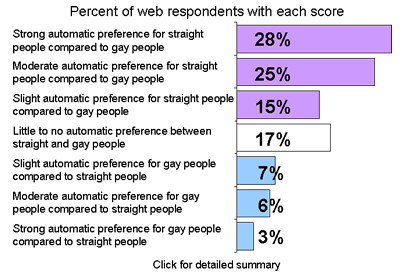
I took a Gay-Straight IAT as part of the reading assignment for my Law & Psychology class next week. The results:

You have completed the Gay - Straight IAT.

Your Result

Your data suggest little to no automatic preference between Gay People and Straight People.

Thank you for your participation. Just below is a breakdown of the scores generated by others. Most respondents find it easier to associate Gay people with Bad and Straight people with Good compared to the reverse.

Sexuality score distribution

Attitudes vary in the degree to which their expression is socially acceptable. For example, to express liking or favorability toward one's school or local sports team is socially acceptable just as it seems to be acceptable, in the appropriate circumstances, to express negative attitudes toward a rival school or sports team.

In recent years, it has become less socially acceptable to express negative attitudes toward some groups, for example groups defined by race or by physical disability. In this context, attitudes toward gay people are of special interest because laboratory studies show that the social acceptability of negative attitudes toward gays has changed relatively little in recent years. We also know that anti-gay attitudes are observed on measures of implicit attitude such as the IAT, and that a person's conscious and implicit attitudes toward gays are more often in agreement with each other than they are for some other socially significant domains.

Many of the questions that you answered on the previous page have been addressed in research over the last 10 years. For example, the order that you performed the response pairing is influential, but procedural corrections largely eliminate that influence (see FAQ #1). Each visitor to the site completes the task in a randomized order. If you would like to learn more about the IAT, please visit the FAQs and background information section.

You are welcome to try additional demonstration tasks, and we encourage you to register (easy) for the research site where you will gain access to studies about more than 100 topics about social groups, personality, pop culture, and more.

FAQs || Research site || Demo site || Project Implicit Home

Copyright © IAT Corp.


Find this IAT and many others at http://implicit.harvard.edu/implicit.

Thursday, January 15, 2009

Fall 2008 Grade Report

I set an uncomfortable precedent for myself in the fall of 2006, receiving the highest grade in my Legal Practice section. The onus fell on the next semester to repeat the feat, but was ultimately unrealized. Then, the focus became to repeat it the following fall--an event again unrealized, albeit much more narrowly. The final permutation of this precedent coalesced into a desire to reflect my mastery in my chosen--I like to think of it as "sovereign"--area of law with the highest grade in Intellectual Property, or at least the first A+ final grade of my law (or, in fact, my entire) school career. (This was due in part to the grading scales applied in college and high school, but the emblematic nature of the "A+" grade, I think, mitigates those niggling factors.)

Also, on a smaller level, I hoped to get at least an A- in my Child Law class, as I had opted to take it for a letter grade in an attempt to bolster my overall GPA into more solid cum laude territory. (My whole matter-of-pride preoccupation with graduation honors I will reserve for another day and entry.)

Today, the grades for these two classes were reported:

Children and the Law: A
Intellectual Property: A+*

*highest grade in class

Ergo:

"Victory is mine!"

Mood: tired, but pleased