Read: Russell Shorto, The Island at the Center of the World: The Epic Story of Dutch Manhattan and the Forgotten Colony that Shaped America
When I published a law article in a small, online-only law journal, I didn't think much would come of it. But, after googling my name out of morbid curiosity a few moments ago, I found that usual search results had nearly doubled.
As graduation nears, and after my change of heart regarding private practice, the possibility of pursuing a career in legal scholarship--most likely in Intellectual Property or Legal Writing--has pressed itself upon me. The cardinal rule of entering the at-times Byzantine world of law faculties is simple: publish, publish, PUBLISH!
(Seeing as my dream job is being a novelist, you might detect a pattern here . . . .)
To this end (and because I want to see my legal scholarship in actual--rather than electronic--print), I've devoted a good portion of this semester toward writing a follow up article. And, as luck would have it, a prof. has encouraged me--and given me the sources I need--to expand a class paper into yet another full-length article, again dealing with the same area I've eeked out as my own scholarly playground: fan-based activities. The first will almost undoubtedly earn me a few hundred bucks worth of a cash reward--possibly more, if I have any success with a national competition. And, with any luck, both articles will see publication by the Fall.
Friday, April 24, 2009

Thursday, January 22, 2009
Implicit Association Test
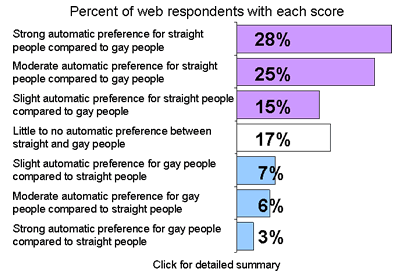
I took a Gay-Straight IAT as part of the reading assignment for my Law & Psychology class next week. The results:
Find this IAT and many others at http://implicit.harvard.edu/implicit.
|

Find this IAT and many others at http://implicit.harvard.edu/implicit.
Thursday, January 15, 2009
Fall 2008 Grade Report
I set an uncomfortable precedent for myself in the fall of 2006, receiving the highest grade in my Legal Practice section. The onus fell on the next semester to repeat the feat, but was ultimately unrealized. Then, the focus became to repeat it the following fall--an event again unrealized, albeit much more narrowly. The final permutation of this precedent coalesced into a desire to reflect my mastery in my chosen--I like to think of it as "sovereign"--area of law with the highest grade in Intellectual Property, or at least the first A+ final grade of my law (or, in fact, my entire) school career. (This was due in part to the grading scales applied in college and high school, but the emblematic nature of the "A+" grade, I think, mitigates those niggling factors.)
Also, on a smaller level, I hoped to get at least an A- in my Child Law class, as I had opted to take it for a letter grade in an attempt to bolster my overall GPA into more solid cum laude territory. (My whole matter-of-pride preoccupation with graduation honors I will reserve for another day and entry.)
Today, the grades for these two classes were reported:
Children and the Law: A
Intellectual Property: A+*
*highest grade in class
Ergo:
 "Victory is mine!"
Also, on a smaller level, I hoped to get at least an A- in my Child Law class, as I had opted to take it for a letter grade in an attempt to bolster my overall GPA into more solid cum laude territory. (My whole matter-of-pride preoccupation with graduation honors I will reserve for another day and entry.)
Today, the grades for these two classes were reported:
Children and the Law: A
Intellectual Property: A+*
*highest grade in class
Ergo:
 "Victory is mine!"
Mood: tired, but pleased
Sunday, November 30, 2008

Friday, November 14, 2008
Oct. 31st, NaNoWriMo, Exile, "Marriage"
Reading: Ender in Exile, Orson Scott Card
Yes, Oct. 31st came and went, and I still don't have a 2nd draft of Book One. But I sucked it up, and started on Book Two promptly on Nov. 1st. I was making good time, too, until the proverbial shit hit the fan in one of my clinic courses, and I was forced to take a week's hiatus from noveling.
So I find myself behind the eight ball yet again.
I'm going to try to get as much as I can done this weekend--if I can coax a good 9000 words or so per day, I'll be back on track for the full 50K by Nov. 30. Gambaru!
Yes, Oct. 31st came and went, and I still don't have a 2nd draft of Book One. But I sucked it up, and started on Book Two promptly on Nov. 1st. I was making good time, too, until the proverbial shit hit the fan in one of my clinic courses, and I was forced to take a week's hiatus from noveling.
So I find myself behind the eight ball yet again.
I'm going to try to get as much as I can done this weekend--if I can coax a good 9000 words or so per day, I'll be back on track for the full 50K by Nov. 30. Gambaru!
*
The recent protests regarding the 52% to 48% passage of California's Prop 8 have pushed me to step up onto my soap box. I usually avoid venting my political views, but it seems that the distinctions that I find to be key to the issue are often overlooked or trodden upon by pundits on both sides.
To begin with, I side with the gay and lesbian viewpoints in that their civil unions should be granted the same rights under the law as traditional married couples. Simply put, it is constitutionally required under the 14th Amendment's equal protection clause, and, even without the Constitution, the time-honored principles of equity, I think, would vindicate their request for equal standing.
Nevertheless, I believe the passage of Prop 8 was a good thing.
The key battleline that most people tend to overlook is one of semantics. The institution of "marriage" extends back into antiquity; it is a cultural touchstone that has shaped human society since the dawn of time, and will likely continue to do so indefinitely. At the same time, inextricably bound up in its cultural significance is its religious meaning--it's no coincidence that the vast majority of marriages take place in churches, and are conducted by religious officials. For a great segment of the multitude of religious perspectives out there, there is spiritual and theological significance bound up in the union of a man and a woman. In this way, the term "marriage" itself is, at its core, a religious one.
Therein lies the danger in the gay and lesbian activists who clamber for their "right" to "gay marriage." They couch their demands in arguments for equal protection, but in demanding that the government sanction their expansive conception of marriage, they seek to have the government impose their view of this quintessentially religious concept upon those whose religious views endorse the traditional viewpoint. That goes beyond the rights ensured by the 14th Amendment; it trods upon the 1st Amendment right to freedom of religion, by demanding that the government impose their conception of marriage upon the masses, or, at least, endorsing it over the traditional conception. Either way, the government finds itself in a position of intermingling matters of church with matters of state, something the founding fathers would find scandalous, and antithetical to the core values of our democracy.
Thus, I find myself in the position of affording gay civil unions equal status under the law as married couples, but insisting that any government recognition of the status of those civil unions restrict itself from treading upon the religious conception of marriage. Some may warn that drawing a distinction between "civil unions" and "marriages" is analogous to the "separate but equal" fallacy of the civil rights era. But I disagree. The inherent weakness of the "separate but equal" doctrine was that the separate institutions provided to whites and blacks simply were not equal--the problem, essentially, was logistical in nature. Here, the separation of the terms "civil union" and "marriage" is semantic: it allows the government to grant equal rights to gay and lesbian unions--rights they are constitutionally due--without taking the extra and unconstitutional step of endorsing the religious viewpoint underlying those unions at the expense of those who favor the traditional conception of marriage. It ensures that neither side of the debate has their constitutional rights abased.
This distinction between "civil union" and "marriage" need only be legal in nature. If U.S. culture grows to include gay and lesbian couples within the popular purview of "marriage," that is something for our culture itself to decide. But the legal distinction must be drawn, lest we, in our zeal to uphold the rights afforded by one amendment, despoil the rights espoused by another.
To begin with, I side with the gay and lesbian viewpoints in that their civil unions should be granted the same rights under the law as traditional married couples. Simply put, it is constitutionally required under the 14th Amendment's equal protection clause, and, even without the Constitution, the time-honored principles of equity, I think, would vindicate their request for equal standing.
Nevertheless, I believe the passage of Prop 8 was a good thing.
The key battleline that most people tend to overlook is one of semantics. The institution of "marriage" extends back into antiquity; it is a cultural touchstone that has shaped human society since the dawn of time, and will likely continue to do so indefinitely. At the same time, inextricably bound up in its cultural significance is its religious meaning--it's no coincidence that the vast majority of marriages take place in churches, and are conducted by religious officials. For a great segment of the multitude of religious perspectives out there, there is spiritual and theological significance bound up in the union of a man and a woman. In this way, the term "marriage" itself is, at its core, a religious one.
Therein lies the danger in the gay and lesbian activists who clamber for their "right" to "gay marriage." They couch their demands in arguments for equal protection, but in demanding that the government sanction their expansive conception of marriage, they seek to have the government impose their view of this quintessentially religious concept upon those whose religious views endorse the traditional viewpoint. That goes beyond the rights ensured by the 14th Amendment; it trods upon the 1st Amendment right to freedom of religion, by demanding that the government impose their conception of marriage upon the masses, or, at least, endorsing it over the traditional conception. Either way, the government finds itself in a position of intermingling matters of church with matters of state, something the founding fathers would find scandalous, and antithetical to the core values of our democracy.
Thus, I find myself in the position of affording gay civil unions equal status under the law as married couples, but insisting that any government recognition of the status of those civil unions restrict itself from treading upon the religious conception of marriage. Some may warn that drawing a distinction between "civil unions" and "marriages" is analogous to the "separate but equal" fallacy of the civil rights era. But I disagree. The inherent weakness of the "separate but equal" doctrine was that the separate institutions provided to whites and blacks simply were not equal--the problem, essentially, was logistical in nature. Here, the separation of the terms "civil union" and "marriage" is semantic: it allows the government to grant equal rights to gay and lesbian unions--rights they are constitutionally due--without taking the extra and unconstitutional step of endorsing the religious viewpoint underlying those unions at the expense of those who favor the traditional conception of marriage. It ensures that neither side of the debate has their constitutional rights abased.
This distinction between "civil union" and "marriage" need only be legal in nature. If U.S. culture grows to include gay and lesbian couples within the popular purview of "marriage," that is something for our culture itself to decide. But the legal distinction must be drawn, lest we, in our zeal to uphold the rights afforded by one amendment, despoil the rights espoused by another.
Sunday, September 28, 2008
ノベルの2nd Draft: Communications Blackout
Thought I should make at least one post in September. Basically, I have just a little over a month left to complete the second draft of the novel by my self-imposed deadline (Oct. 31st!), all the while juggling my law school responsibilities at the same time. As a result, the going is . . . well, going to be tough, so I'm instituting an official blogging communications blackout until Oct. 31st or the 2nd draft is in hand, whichever may come first.
Here's hoping it's the latter--and peace until then.
Here's hoping it's the latter--and peace until then.
Saturday, August 23, 2008
Expresso & Publication
Watching: Macross Frontier #19, The Middleman #10
Reading: A Feast For Crows, George R.R. Martin
No word count for today. Too busy gearing up for the start of the semester.
Reading: A Feast For Crows, George R.R. Martin
No word count for today. Too busy gearing up for the start of the semester.
*
About three years ago, when I first sent out a slew of short stories to various SF periodicals, I took the advice of Stephen King (and several other authors) and established a "rejection" folder, for all of the rejection letters I would receive. And soon enough, the letters arrived for me to start my collection. All of them are the standard form letter--the only minor exception being a letter from the Writers of the Future contest, which included a handwritten note consisting of three words: "send more soon!"
Well, my novel gobbled up my off year, and then law school came by, so I never did.
Flash forward to this summer. I had a law article burning a hole in my pocket--the fore-mentioned seminar paper focusing on doujinshi, fansubs, and fair use--but refrained from submitting it on the promise of my seminar professor, who promised that he would contact his students during the summer in case any of them wanted to further refine their papers for future publication. Well, come August, and I still hadn't heard anything from him. So, on a whim, I decided to send out the paper as-is.
A note on the Expresso website is called for here. Berkeley Press has a wonderful submission hub website, which allows you to easily submit your law articles to over 500 law journals with the click of a few buttons. The only limit on the number of submissions is the size of your wallet: Expresso charges $2 per electronic submission, minus the first, which they send for free. I checked off mostly IP law journals, and sent it off.
For the first week, I received two rejection emails, and one email noting that I had submitted to a journal that only accepted student-written pieces that were authored by its own students. (Chalk that one up to an overactive clicking thumb.) Another rejection followed a few days into week two. Feeling a bit desperate, I took a (figurative) axe to my paper in order to trim it down to the rather tight space requirements of my alma mater's law review, and sent the resulting frankenstein to one of our EICs.
Then, early this morning, I received a different sort of email from one of the Expresso law journals, entitled "Offer of Publication."
While the sight of that email left me positively giddy, never for a second did I forget that the battle is only beginning. Yes, with an offer in hand, I can be assured that my paper will be published in a scholarly journal, and that I now have a publication credit add to my resume (my only other published piece was in the high school literary magazine, hardly worth a line or two of precious resume real estate).
There are, however, considerations to be made. The accepting journal is relatively new, and, from my own investigations, doesn't seem to be represented on Westlaw or LexisNexis's online databases. As a result, I would much prefer to see my article published in a journal with greater name recognition and/or a wider sphere of distribution. So the tool of choice to exact a response from as-of-yet silent law journals is the "expedited review request."
Through Expresso, one can contact all of the law journals that one has submitted to, and inform them of your standing offer and its acceptance deadline. With that deadline in mind, you then request that the journal "expedite" its review of your article, so that you'll know whether they want it before you have to give your response to the initial offerer.
So, while publication is now all but certain, it's still a waiting game.
The acceptance deadline is September 8th.
I'll keep you posted.
Well, my novel gobbled up my off year, and then law school came by, so I never did.
Flash forward to this summer. I had a law article burning a hole in my pocket--the fore-mentioned seminar paper focusing on doujinshi, fansubs, and fair use--but refrained from submitting it on the promise of my seminar professor, who promised that he would contact his students during the summer in case any of them wanted to further refine their papers for future publication. Well, come August, and I still hadn't heard anything from him. So, on a whim, I decided to send out the paper as-is.
A note on the Expresso website is called for here. Berkeley Press has a wonderful submission hub website, which allows you to easily submit your law articles to over 500 law journals with the click of a few buttons. The only limit on the number of submissions is the size of your wallet: Expresso charges $2 per electronic submission, minus the first, which they send for free. I checked off mostly IP law journals, and sent it off.
For the first week, I received two rejection emails, and one email noting that I had submitted to a journal that only accepted student-written pieces that were authored by its own students. (Chalk that one up to an overactive clicking thumb.) Another rejection followed a few days into week two. Feeling a bit desperate, I took a (figurative) axe to my paper in order to trim it down to the rather tight space requirements of my alma mater's law review, and sent the resulting frankenstein to one of our EICs.
Then, early this morning, I received a different sort of email from one of the Expresso law journals, entitled "Offer of Publication."
While the sight of that email left me positively giddy, never for a second did I forget that the battle is only beginning. Yes, with an offer in hand, I can be assured that my paper will be published in a scholarly journal, and that I now have a publication credit add to my resume (my only other published piece was in the high school literary magazine, hardly worth a line or two of precious resume real estate).
There are, however, considerations to be made. The accepting journal is relatively new, and, from my own investigations, doesn't seem to be represented on Westlaw or LexisNexis's online databases. As a result, I would much prefer to see my article published in a journal with greater name recognition and/or a wider sphere of distribution. So the tool of choice to exact a response from as-of-yet silent law journals is the "expedited review request."
Through Expresso, one can contact all of the law journals that one has submitted to, and inform them of your standing offer and its acceptance deadline. With that deadline in mind, you then request that the journal "expedite" its review of your article, so that you'll know whether they want it before you have to give your response to the initial offerer.
So, while publication is now all but certain, it's still a waiting game.
The acceptance deadline is September 8th.
I'll keep you posted.
Subscribe to:
Posts (Atom)


